
Thinking about an AI assistant for your business? I build real-estate and SMB AI assistants that understand people — in English, Dutch, and Arabic. Get a quote →
When people hear about AI chatbots today, they often imagine a tool that answers questions and saves a business some time. While that’s certainly part of what AI can do, it wasn’t the vision that inspired us.
Our story didn’t begin with the goal of building another chatbot.
It began with a simple question:
What if a real estate website could actually understand its visitors instead of simply responding to their questions?
That question eventually grew into a project that occupied us for more than four months, changed the way we thought about AI, and continues to evolve every day.
It Started With an Idea
At the time, my colleague and I were working on RealWorks API integrations for two real estate clients in the Netherlands. The project itself had nothing to do with AI initially. We were focused on connecting property data and improving the websites.
One of my colleagues, Victor, has always been passionate about AI. Whenever there’s an opportunity to use AI to improve something, he’s usually the first person to suggest it. One day he asked a simple question:
“What if we built something and showed it to one of our clients?”
At first, I didn’t think about building a chatbot.
In my mind, I was imagining something much bigger.
I wanted to create something that could quietly observe what happened on a real estate website, almost like Google Analytics—but instead of only measuring traffic, it would understand visitor behavior.
Which properties attracted attention?
How long did someone spend reading a listing?
Where did they stop scrolling?
What information were they looking for?
Which questions kept coming up?
Could the website recognize whether someone was casually browsing or seriously planning to buy a home?
Those questions became the foundation of everything we built.
Building Something Bigger Than a Chatbot
As development progressed, we realized we weren’t building a chatbot.
We were building an AI assistant.
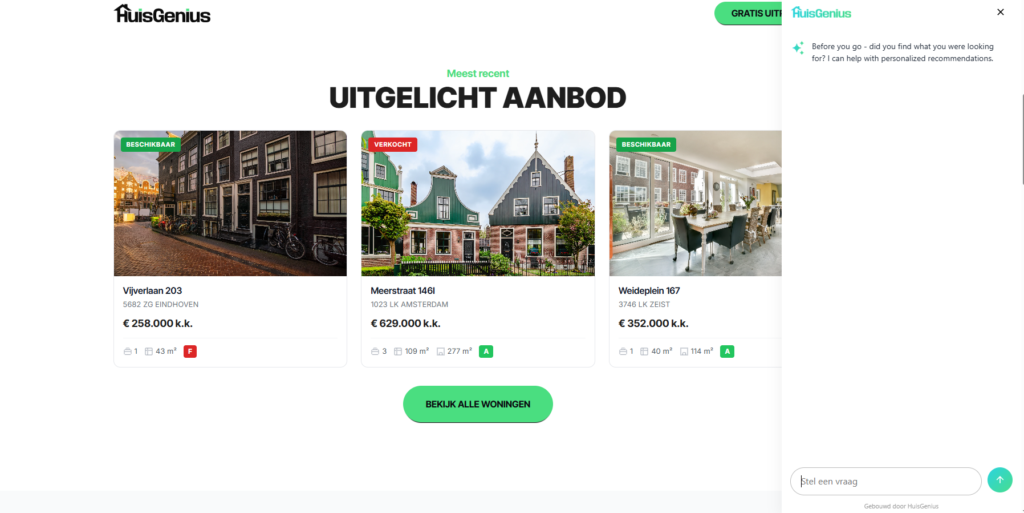
An assistant that could answer questions, recommend properties, understand visitor intentions, and know when it was time to involve a real estate professional.
From the beginning, we wanted the system to be independent of any single platform.
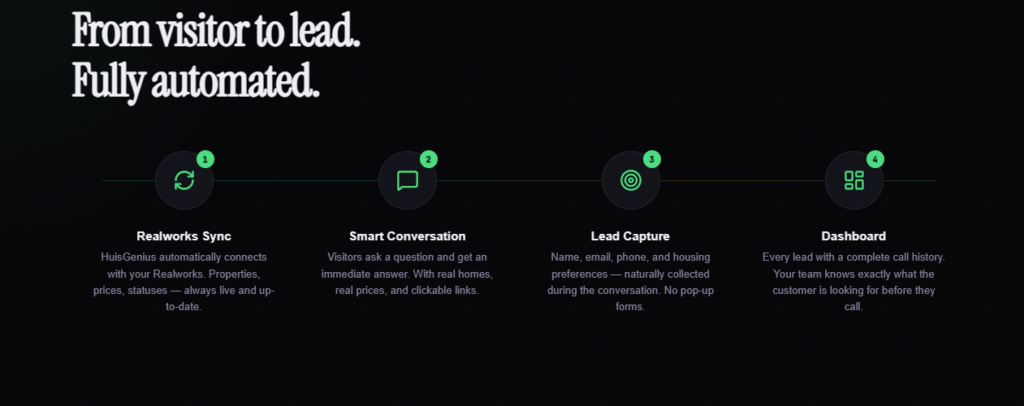
Although our first implementation worked with RealWorks, we deliberately designed the architecture so it could integrate with virtually any real estate API provider in the future.
That decision required more work early on, but it made the project far more flexible.
Four Months of Learning
For more than four months, we worked on the project before showing a working demonstration.
We built the backend using JavaScript, Node.js, and PHP.
For semantic search and knowledge retrieval, we integrated AgentDB to help the assistant find relevant information quickly and accurately.
Rather than relying on a single AI model, we built our own routing strategy that allows different AI capabilities to work together while maintaining context throughout a conversation.
The technology mattered.
But what mattered even more was making the assistant behave naturally.
The Biggest Challenge Had Nothing to Do With Code
Ironically, the hardest problem wasn’t technical.
It was language.
I don’t speak Dutch.
Every property description.
Every customer conversation.
Every question.
Every response.
Everything happened in Dutch.
While developing, I worked almost entirely in English. As we approached production, Victor carefully reviewed the conversations, refined the language, and shared the chatbot with Dutch-speaking colleagues and friends for testing.
That experience taught me something I hadn’t fully appreciated before.
Speaking a language isn’t enough.
Understanding how people naturally communicate is completely different.
Dutch has formal expressions, informal expressions, regional differences, and subtle ways of asking questions that can completely change the tone of a conversation.
Watching native speakers improve those conversations taught me just as much as writing the software itself.
Even today, I’m still learning Dutch because I want to understand the users we’re building for.
Understanding Buyer Intent
One thing we quickly realized was that people rarely ask exactly what they want.
Someone might write:
“I’m looking around.”
Another person asks:
“Can I schedule a viewing?”
Someone else says:
“What’s my house worth?”
On the surface, they’re all chatting with the website.
In reality, they’re at completely different stages of their journey.
Instead of treating every conversation the same way, our assistant tries to understand the visitor’s intent.
It combines the conversation with behavioral signals from the website itself.
It notices which properties someone has viewed.
How long they spent reading each listing.
Whether they carefully explored the specifications or only glanced at the photos.
Whether they’ve returned to the same property multiple times.
Instead of simply reacting to questions, the assistant builds context over time.
That context allows it to offer more relevant suggestions and ask better follow-up questions.
Knowing When AI Should Step Aside
One of our design principles was simple:
AI doesn’t have to answer everything.
There are situations where people deserve to speak with another person.
Scheduling a property viewing.
Discussing the value of a home.
Talking about market conditions.
Negotiating a purchase.
Those conversations require local knowledge, experience, and sometimes simply a human touch.
When the assistant recognizes those situations—or when it doesn’t have enough reliable information—it hands the conversation over to a real estate agent instead of trying to guess.
To us, that’s not a limitation.
It’s good design.
Building Trust Before Answers
One of the biggest challenges with modern AI systems is hallucination—when the model confidently generates information that isn’t actually true.
In real estate, that’s unacceptable.
Incorrect information about a property, its availability, or its price can quickly damage trust.
To reduce that risk, we designed the assistant to rely on trusted sources before generating a response.
Property information comes from structured data, including RealWorks, website content, and carefully prepared property search tables.
AgentDB helps retrieve the right context, while caching improves both speed and consistency.
Only after collecting trustworthy information does the AI generate a response.
That architecture allows us to balance natural conversation with factual accuracy.
Our First Client Helped Build the Product
When we finally presented the system, it wasn’t to the client we originally had in mind.
Instead, another large real estate agency became our first customer.
Looking back, that turned out to be one of the best things that could have happened.
They didn’t just use the product.
They challenged it.
They suggested improvements.
They asked difficult questions.
They showed us how real agents actually work with customers.
Many of the features that exist today were inspired by their feedback rather than our original plans.
Good software isn’t built in isolation.
It’s shaped by the people who use it.
This Project Reminded Me Why I Started Programming
Long before AI became mainstream, I was already fascinated by conversations between humans and computers.
Back in the early 2000s, I built simple C++ applications that could simulate conversations using predefined responses.
Looking back now, those projects seem incredibly limited compared to today’s large language models.
But the dream was the same.
I wanted to build software that could communicate naturally with people.
Today’s AI hasn’t changed that dream.
It has simply made it possible in ways I couldn’t have imagined back then.
What I Learned
This project taught me far more than AI frameworks or APIs.
It reminded me that great software is rarely built by one person.
Victor brought ideas that pushed the project in directions I hadn’t considered.
Our teammates tested countless conversations and shared honest feedback.
Native Dutch speakers improved the quality of the language.
Our client challenged our assumptions and helped shape the product into something genuinely useful.
Even our designer played an important role by creating an interface that made property recommendations feel natural and easy to explore.
Every new person who joins the project brings a different perspective.
Every new client teaches us something.
Every conversation makes the assistant a little better.
That’s one of the things I enjoy most about working in technology.
Learning never stops.
Looking Ahead
Although the assistant is already working around the clock—24 hours a day, seven days a week—we still see it as the beginning.
There are countless improvements we want to make.
Better behavioral understanding.
More intelligent recommendations.
Smarter personalization.
Additional integrations with CRMs, databases, and real estate platforms.
The goal has never been to build the perfect chatbot.
The goal has always been to build an assistant that genuinely helps both visitors and real estate professionals.
A Thought I’d Like to Leave You With
People often ask whether AI will replace human jobs.
After spending months building this system, my answer is still the same.
I don’t build chatbots to replace people. I build them to work alongside us and improve our quality of life.
The best AI doesn’t replace expertise.
It supports it.
It handles repetitive work.
It provides better information.
It creates better experiences for customers.
And when the moment calls for human judgment, empathy, or experience, it knows it’s time to let people take over.
That’s the kind of AI I want to keep building.
A Personal Thank You
No meaningful project is built alone.
I’d like to thank Victor for constantly pushing new AI ideas into the project and challenging us to think beyond what we originally planned. I’d also like to thank everyone on our team who spent time testing conversations, reviewing responses, sharing feedback, improving the Dutch language, designing the interface, and helping us refine the system.
Most importantly, I’d like to thank our first client. Their openness, suggestions, and willingness to challenge our assumptions helped shape this assistant into something far better than our original vision.
This project is still growing, and so are we. I hope that when I look back a few years from now, this article will simply mark the beginning of a much bigger journey.
If you’re interested in AI for real estate, customer behavior analysis, or simply want to see what we’ve been building, I’d love to hear your thoughts. You can learn more about HuisGenius at https://huisgenius.nl/ or connect with me through my website.
Related reading
If you liked this, see Building a Kodi Add-on That Unifies Netflix, Shahid, and Your Local Library — how I unified four streaming services into one Raspberry-Pi-ready Kodi menu.